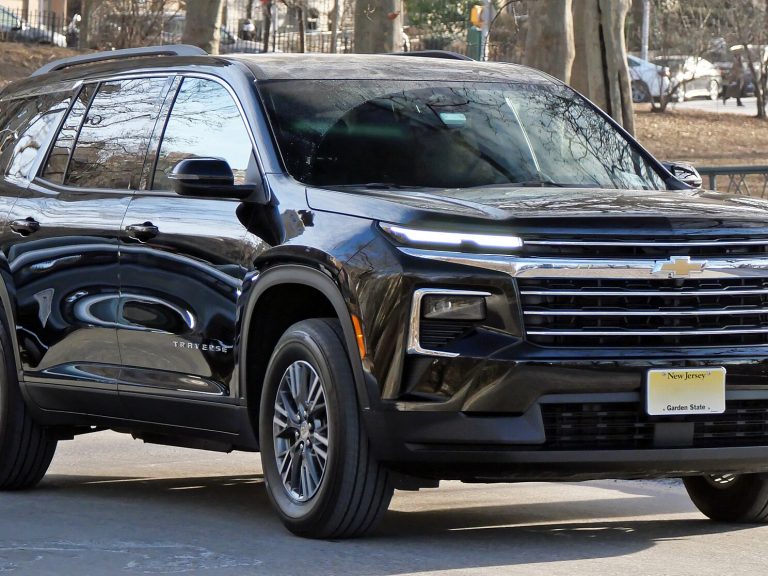
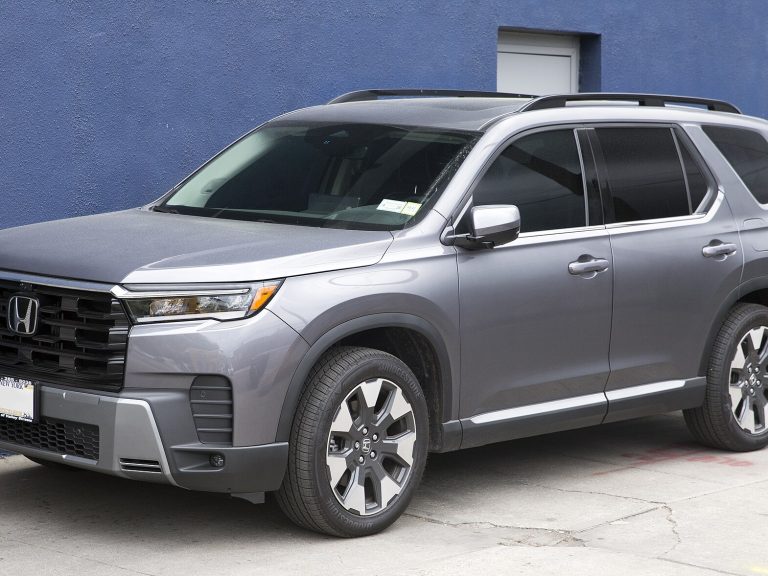
Traverse vs Pilot
Rivals in the three-row suv class rarely match spec for spec, and the Traverse and the Pilot are no exception. If you only read one line, make it this: the Traverse takes 4 of 5 compared areas, and the engine & performance gap is the one to look at first.
At a glance
- Engine & Performance Traverse wins
- Fuel Economy & Range Traverse wins
- Space & Practicality Traverse wins
- Off-road & Towing Tie
- Safety & Tech Traverse wins
- Price Traverse wins
- Engine & Performance7.6
- Fuel Economy & Range4.8
- Space & Practicality10.0
- Off-road & Towing5.3
- Engine & Performance4.9
- Fuel Economy & Range2.8
- Space & Practicality6.0
- Off-road & Towing5.3
Spec scores (0 to 10) are calculated from manufacturer specs against other models in the same class. See how the formula works. They are not reviews or user ratings.
Key Differences
-
The Traverse has 24% more cargo space
This is a headline difference. With 23 cu ft to the Pilot’s 18.6 cu ft, the Traverse has a lead that’s easy to see on paper and in practice. Cargo space behind the rear seats is what you use every day for groceries, strollers and luggage.
-
The Traverse has 43 hp more power
Put simply, the Traverse is far ahead here: 328 hp compared with 285 hp. The Traverse’s extra output gives it more in reserve when you need to get up to speed.
-
The Traverse has 64 lb-ft more torque
The Traverse’s 326 lb-ft leaves the Pilot’s 262 lb-ft well behind, so if this spec matters to you, the choice is easy. Electrified powertrains deliver torque instantly, so compare torque figures alongside the powertrain type.
-
The Traverse has a bigger 17.7 in touchscreen
Not a close call. The Traverse lists 17.7 in and the Pilot lists 12.3 in. That’s a substantial gap. The Traverse’s larger display gives navigation and menus more room.
-
The Traverse has 13% more maximum cargo space
If everything else were equal, this small edge would favor the Traverse: 98.2 cu ft against 87 cu ft. The Traverse can swallow more with the seats down, which makes it more versatile for occasional big loads.
Design & Size
In overall size, the Traverse and the Pilot are close enough that you’d struggle to tell them apart by dimensions alone.
Dimensions
| Spec | Traverse | Pilot |
|---|---|---|
| Length | 204 in | 200.1 in |
| Width (no mirrors) | N/A (not specified) | 78.5 in |
| Height | N/A (not specified) | 71 in |
| Wheelbase | 120.9 in | 113.8 in |
Engine & Performance
Traverse leads
The Traverse is the clear pick if engine & performance is what you care about most. The Traverse adds 43 hp more power. Power is only part of the story; weight, gearing and torque delivery shape how quick a car feels. For engine & performance, the Traverse is the one to beat.
Total system output
Traverse: 328 hp Pilot: 285 hp More power helps with merging, overtaking and climbing hills, especially with passengers and luggage on board.
Torque
Traverse: 326 lb-ft Pilot: 262 lb-ft More torque means stronger pulling from low speeds, which you feel when accelerating from a stop or climbing grades.
Fuel Economy & Range
Traverse leads
The fuel economy & range numbers lean toward the Traverse, not dramatically but consistently. The Traverse wins here with better city fuel economy. City fuel economy matters most if your driving is mostly short trips, traffic and stop-and-go commutes. Weighing only fuel economy & range, the Traverse comes out ahead.
Fuel economy (city)
Traverse: 20 mpg Pilot: 19 mpg Hybrids often shine in the city, and the Traverse has the better rating here.
Space & Practicality
Traverse leads
Few areas are as clear-cut as this one: the Traverse leads the space & practicality section with room to spare. The Traverse delivers 24% more cargo space. The Traverse’s larger cargo area makes family trips and big shopping runs easier. Anyone shopping mainly on space & practicality should start with the Traverse.
Cargo (behind rear seats)
Traverse: 23 cu ft Pilot: 18.6 cu ft Cargo figures are measured in different ways by different makers, so small gaps may not show in practice.
Cargo (seats folded)
Traverse: 98.2 cu ft Pilot: 87 cu ft Check the shape of the load floor too: a flat floor can matter as much as the number.
Off-road & Towing
Too close to call
Call the off-road & towing round a draw. This section won’t settle the choice, so weigh the other areas more heavily.
Safety & Tech
Traverse leads
The Pilot comes close on safety & tech, but the Traverse does just enough to lead. The Traverse brings a bigger 17.7 in touchscreen. Screen size isn’t everything (physical controls and software speed matter too), but bigger is easier to read. Net result: the Traverse leads this part of the comparison.
Largest touchscreen
Traverse: 17.7 in Pilot: 12.3 in A bigger touchscreen makes maps and phone mirroring easier to read at a glance.
Full Specifications
Engine & Performance
| Spec | Traverse | Pilot |
|---|---|---|
| Powertrain | Gas | Gas |
| Engine | 2.5L turbo I4 | 3.5L V6 |
| Total system output | 328 hp (winner) | 285 hp |
| Torque | 326 lb-ft (winner) | 262 lb-ft |
| Transmission | 8-speed automatic | 10-speed automatic |
| Drivetrain | FWD (AWD available) | FWD (AWD available) |
Fuel Economy & Range
| Spec | Traverse | Pilot |
|---|---|---|
| Fuel economy (combined)EPA estimate where available | 23 mpg | 22 mpg |
| Fuel economy (city) | 20 mpg (winner) | 19 mpg |
| Fuel economy (highway) | 27 mpg | 27 mpg |
| Fuel tank | N/A (not specified) | 18.5 gal |
Space & Practicality
| Spec | Traverse | Pilot |
|---|---|---|
| Seats | 8 seats | 8 seats |
| Cargo (behind rear seats) | 23 cu ft (winner) | 18.6 cu ft |
| Cargo (seats folded) | 98.2 cu ft (winner) Most room, seats folded | 87 cu ft |
Off-road & Towing
| Spec | Traverse | Pilot |
|---|---|---|
| Max towing | 5,000 lb | 5,000 lb |
| AWD / 4WD available | Yes | Yes |
Safety & Tech
| Spec | Traverse | Pilot |
|---|---|---|
| Largest touchscreen | 17.7 in (winner) Biggest touchscreen | 12.3 in |
| Driver-assist suite | Chevy Safety Assist | Honda Sensing |
| Basic warranty | 3 yr / 36,000 mi | 3 yr / 36,000 mi |
Dimensions
| Spec | Traverse | Pilot |
|---|---|---|
| Length | 204 in | 200.1 in |
| Width (no mirrors) | N/A (not specified) | 78.5 in |
| Height | N/A (not specified) | 71 in |
| Wheelbase | 120.9 in | 113.8 in |
Price
| Spec | Traverse | Pilot |
|---|---|---|
| Starting MSRP | $40,700 (winner) | $42,395 |
“N/A” means the manufacturer does not specify the value or we could not confirm it. Figures marked “manufacturer rating” are the maker’s own claims, not our measurements.
Price & Value
The launch price difference is small: $1,695, favoring the Traverse. The Pilot asks $1,695 more without winning more areas, which tilts value firmly toward the Traverse.
Prices shown are US launch prices as of launch. Retail prices change often, so it’s worth checking current offers.
Which One Should You Buy?
Choose the Traverse if…
- you want more cargo space behind the rear seats (23 cu ft vs 18.6 cu ft)
- you merge, overtake or climb hills with a full load (328 hp vs 285 hp)
- you want more pulling power from low speeds (326 lb-ft vs 262 lb-ft of torque)
- you rely on navigation and phone mirroring on a larger display (17.7 in vs 12.3 in)
- you’re working to a firm budget and $1,695 matters
Also Compared
Frequently Asked Questions
Which is better for most people, the Traverse or the Pilot?
On the specs compared here, the Traverse makes more sense for most buyers; the Pilot doesn’t win a single measurable area.
Is the Traverse bigger than the Pilot?
The Traverse and the Pilot are so close in size that you’d struggle to tell them apart on dimensions alone.
Is the Traverse cheaper than the Pilot?
At launch, the Traverse undercut the Pilot by $1,695. These figures are as of launch, and street prices can change.
Executive Summary
Chevrolet or Honda? For a lot of people, the question really comes down to the Traverse versus the Pilot. What tips it for me is that the Traverse has 24% more cargo space. Add 43 hp more power to the list, and the Traverse looks even better.
Put simply, the Traverse suits people who care about engine & performance, while the Pilot suits people who put the things a spec sheet can’t capture first.
My pick: the Traverse.
Personal opinion based on the data above. Your priorities may differ.