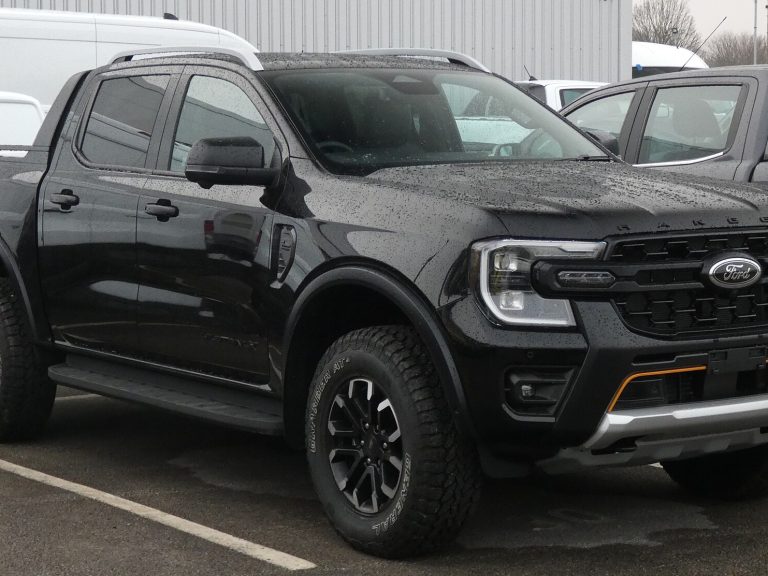
Ranger vs Ridgeline
Few matchups in the midsize pickup class come up as often as the Ranger against the Ridgeline. If you only read one line, make it this: the Ranger takes 4 of 5 compared areas, and the fuel economy & range gap is the one to look at first. The Ranger launched $7,245 lower than the Ridgeline, so every advantage on the pricier side has to earn its keep.
At a glance
- Engine & Performance Ranger wins
- Fuel Economy & Range Ranger wins
- Space & Practicality Tie
- Off-road & Towing Ranger wins
- Safety & Tech Ranger wins
- Price Ranger wins
- Engine & Performance4.5
- Fuel Economy & Range10.0
- Off-road & Towing9.7
- Engine & Performance4.2
- Fuel Economy & Range2.9
- Off-road & Towing5.7
Spec scores (0 to 10) are calculated from manufacturer specs against other models in the same class. See how the formula works. They are not reviews or user ratings.
Key Differences
-
The Ranger has 2,500 lb more towing capacity
On this line of the spec sheet, the Ranger is in a different league: 7,500 lb, next to 5,000 lb for the Ridgeline. A higher towing capacity lets you pull bigger trailers, boats and campers.
-
The Ranger has 48 lb-ft more torque
For torque, the Ranger leads by a wide margin: 310 lb-ft versus 262 lb-ft. More torque means stronger pulling from low speeds, which you feel when accelerating from a stop or climbing grades.
-
The Ranger has better fuel economy
Close, but not identical: the Ranger lists 23 mpg and the Ridgeline lists 21 mpg. The Ranger uses less fuel on the standard combined cycle, which matters most if you drive a lot.
-
The Ranger has a bigger 12 in touchscreen
This is a headline difference. With 12 in to the Ridgeline’s 9 in, the Ranger has a lead that’s easy to see on paper and in practice. The Ranger’s larger display gives navigation and menus more room.
-
The Ranger has better city fuel economy
Put simply, the Ranger is far ahead here: 21 mpg compared with 18 mpg. City fuel economy matters most if your driving is mostly short trips, traffic and stop-and-go commutes.
Design & Size
Their dimensions are close enough that size should be one of the last things you weigh.
Dimensions
| Spec | Ranger | Ridgeline |
|---|---|---|
| Length | 210.8 in | 210.2 in |
| Width (no mirrors) | N/A (not specified) | 78.6 in |
| Height | N/A (not specified) | 70.8 in |
| Wheelbase | 128.7 in | 125.2 in |
Engine & Performance
Ranger leads
When it comes to engine & performance, the Ranger is comfortably ahead. Choose the Ranger and you get 48 lb-ft more torque. Electrified powertrains deliver torque instantly, so compare torque figures alongside the powertrain type. Net result: the Ranger leads this part of the comparison.
Torque
Ranger: 310 lb-ft Ridgeline: 262 lb-ft The Ranger’s extra torque makes it more relaxed when fully loaded or towing.
Fuel Economy & Range
Ranger leads
No contest in fuel economy & range: the Ranger is the stronger of the two. The Ranger makes its case with better fuel economy. Official figures rarely match real-world driving exactly, but the ranking between two cars tends to hold. For fuel economy & range, the Ranger is the one to beat.
Fuel economy (combined)
Ranger: 23 mpg Ridgeline: 21 mpg Better combined fuel economy lowers your running costs every week, and the savings add up over years of ownership.
Fuel economy (city)
Ranger: 21 mpg Ridgeline: 18 mpg Hybrids often shine in the city, and the Ranger has the better rating here.
Space & Practicality
Too close to call
Neither the Ranger nor the Ridgeline has a real advantage in the space & practicality category. Neither car gives you a reason to choose it on space & practicality.
Off-road & Towing
Ranger leads
The Ranger wins the off-road & towing section decisively. In its favor, the Ranger has 2,500 lb more towing capacity. If you tow regularly, the Ranger’s higher rating gives you more margin. On off-road & towing alone, the Ranger gets the nod.
Max towing
Ranger: 7,500 lb Ridgeline: 5,000 lb Towing ratings depend on configuration and equipment, so check the exact trim you’re looking at.
Safety & Tech
Ranger leads
In the safety & tech category, the Ranger is a step ahead rather than a leap ahead. The Ranger scores with a bigger 12 in touchscreen. Screen size isn’t everything (physical controls and software speed matter too), but bigger is easier to read. Bottom line for safety & tech: the Ranger has the edge.
Largest touchscreen
Ranger: 12 in Ridgeline: 9 in A bigger touchscreen makes maps and phone mirroring easier to read at a glance.
Full Specifications
Engine & Performance
| Spec | Ranger | Ridgeline |
|---|---|---|
| Powertrain | Gas | Gas |
| Engine | 2.3L turbo I4 (EcoBoost) | 3.5L V6 |
| Total system output | 270 hp | 280 hp |
| Torque | 310 lb-ft (winner) | 262 lb-ft |
| Transmission | 10-speed automatic | 9-speed automatic |
| Drivetrain | RWD (4x4 available) | AWD |
Fuel Economy & Range
| Spec | Ranger | Ridgeline |
|---|---|---|
| Fuel economy (combined)EPA estimate where available | 23 mpg (winner) Most efficient in class | 21 mpg |
| Fuel economy (city) | 21 mpg (winner) Best city economy | 18 mpg Thirstiest in the city |
| Fuel economy (highway) | 26 mpg (winner) Best highway economy | 24 mpg |
| Fuel tank | 18 gal | 19.5 gal |
Space & Practicality
| Spec | Ranger | Ridgeline |
|---|---|---|
| Seats | 5 seats | 5 seats |
Off-road & Towing
| Spec | Ranger | Ridgeline |
|---|---|---|
| Max towing | 7,500 lb (winner) | 5,000 lb |
| AWD / 4WD available | Yes | Yes |
Safety & Tech
| Spec | Ranger | Ridgeline |
|---|---|---|
| Largest touchscreen | 12 in (winner) | 9 in Smallest touchscreen |
| Driver-assist suite | Ford Co-Pilot360 | Honda Sensing |
| Basic warranty | 3 yr / 36,000 mi | 3 yr / 36,000 mi |
Dimensions
| Spec | Ranger | Ridgeline |
|---|---|---|
| Length | 210.8 in | 210.2 in |
| Width (no mirrors) | N/A (not specified) | 78.6 in |
| Height | N/A (not specified) | 70.8 in |
| Wheelbase | 128.7 in | 125.2 in |
Price
| Spec | Ranger | Ridgeline |
|---|---|---|
| Starting MSRP | $33,350 (winner) | $40,595 Priciest in class |
“N/A” means the manufacturer does not specify the value or we could not confirm it. Figures marked “manufacturer rating” are the maker’s own claims, not our measurements.
Price & Value
The price gap is wide: $7,245 at launch, which is 22% of difference between the Ranger and the Ridgeline. If value matters, the Ranger makes a strong case: it saves $7,245 and wins more of the comparison.
Prices shown are US launch prices as of launch. Retail prices change often, so it’s worth checking current offers.
Which One Should You Buy?
Choose the Ranger if…
- you want the higher towing capacity (7,500 lb vs 5,000 lb)
- you want more pulling power from low speeds (310 lb-ft vs 262 lb-ft of torque)
- you want better combined fuel economy (23 mpg vs 21 mpg)
- you rely on navigation and phone mirroring on a larger display (12 in vs 9 in)
- you’d rather keep $7,245 in your pocket
Also Compared
Frequently Asked Questions
Should I buy the Ranger or the Ridgeline?
On the specs compared here, the Ranger makes more sense for most buyers; the Ridgeline doesn’t win a single measurable area.
Is the Ranger bigger than the Ridgeline?
They’re practically the same size. The difference between the Ranger and the Ridgeline is too small to matter.
Is the Ranger cheaper than the Ridgeline?
The Ranger is the cheaper option, launching at $7,245 less than the Ridgeline (launch prices as of launch).
Executive Summary
The Ranger versus the Ridgeline is a matchup I find genuinely interesting, because Ford and Honda made different bets. It’s hard to argue with 2,500 lb more towing capacity, which is exactly what the Ranger brings. Another thing in the Ranger’s favor is 48 lb-ft more torque.
In my head, the Ranger is the engine & performance pick and the Ridgeline is the the things a spec sheet can’t capture pick.
My pick: the Ranger.
Personal opinion based on the data above. Your priorities may differ.