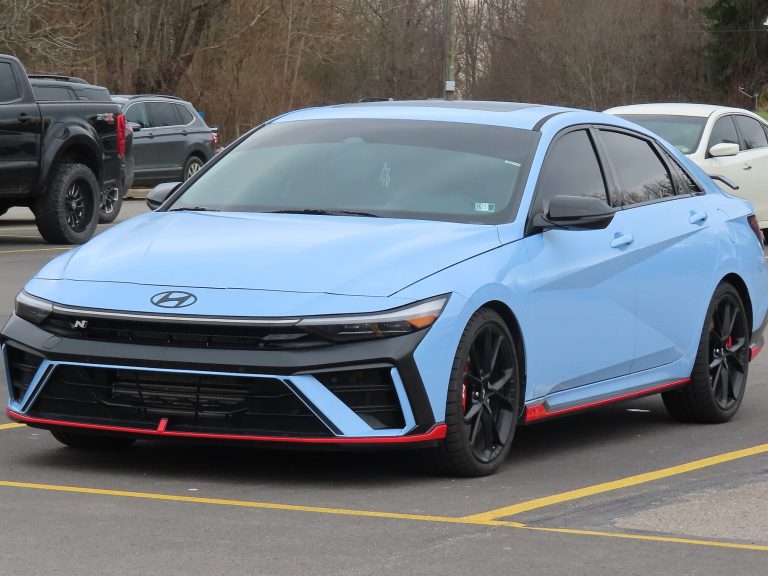
Elantra vs WRX
It’s Hyundai against Subaru in the compact car class, and the Elantra and the WRX are the models carrying each flag. Across 4 compared areas, the Elantra takes 2. The widest gap shows up under fuel economy & range.
At a glance
- Engine & Performance WRX wins
- Fuel Economy & Range Elantra wins
- Space & Practicality Elantra wins
- Off-road & Towing WRX wins
- Engine & Performance0.0
- Fuel Economy & Range6.4
- Space & Practicality4.8
- Engine & Performance7.3
- Fuel Economy & Range0.0
- Space & Practicality4.0
Spec scores (0 to 10) are calculated from manufacturer specs against other models in the same class. See how the formula works. They are not reviews or user ratings.
Key Differences
-
The WRX has 124 hp more power
The Elantra is clearly behind on total system output (147 hp against 271 hp), and that’s one of its biggest weak spots in this matchup. More power helps with merging, overtaking and climbing hills, especially with passengers and luggage on board.
-
The Elantra has better fuel economy
On this line of the spec sheet, the Elantra is in a different league: 36 mpg, next to 22 mpg for the WRX. Better combined fuel economy lowers your running costs every week, and the savings add up over years of ownership.
-
The WRX has 126 lb-ft more torque
For torque, the WRX leads by a wide margin: 258 lb-ft versus 132 lb-ft. The WRX’s extra torque makes it more relaxed when fully loaded or towing.
-
The Elantra has 14% more cargo space
Slight advantage to the Elantra: 14.2 cu ft compared with 12.5 cu ft. The Elantra’s larger cargo area makes family trips and big shopping runs easier.
-
The Elantra has better city fuel economy
This is a headline difference. With 32 mpg to the WRX’s 19 mpg, the Elantra has a lead that’s easy to see on paper and in practice. In town, driving style has a big effect, but the Elantra starts from a better baseline.
Design & Size
- Elantra 184.1 in × 71.9 in × 55.7 in
- WRX 183.8 in × 71.9 in × 57.8 in
A larger body can leave more room inside, while a smaller one is easier to live with in tight spaces. Here, the WRX is the larger car.
Dimensions
| Spec | Elantra | WRX |
|---|---|---|
| Length | 184.1 in | 183.8 in |
| Width (no mirrors) | 71.9 in | 71.9 in |
| Height | 55.7 in | 57.8 in |
| Wheelbase | 107.1 in | 105.4 in |
Engine & Performance
WRX leads
For engine & performance, the verdict is easy: the WRX leads, and not by a little. The WRX takes this one with 124 hp more power. The WRX’s extra output gives it more in reserve when you need to get up to speed. If engine & performance is your priority, the WRX is the car to pick.
Total system output
Elantra: 147 hp WRX: 271 hp Power is only part of the story; weight, gearing and torque delivery shape how quick a car feels.
Torque
Elantra: 132 lb-ft WRX: 258 lb-ft Electrified powertrains deliver torque instantly, so compare torque figures alongside the powertrain type.
Fuel Economy & Range
Elantra leads
In this area the Elantra has a lead the WRX can’t close. Here the Elantra offers better fuel economy. Official figures rarely match real-world driving exactly, but the ranking between two cars tends to hold. Net result: the Elantra leads this part of the comparison.
Fuel economy (combined)
Elantra: 36 mpg WRX: 22 mpg The Elantra uses less fuel on the standard combined cycle, which matters most if you drive a lot.
Fuel economy (city)
Elantra: 32 mpg WRX: 19 mpg City fuel economy matters most if your driving is mostly short trips, traffic and stop-and-go commutes.
Space & Practicality
Elantra leads
The Elantra takes space & practicality by a nose. The Elantra delivers 14% more cargo space. Cargo figures are measured in different ways by different makers, so small gaps may not show in practice. Prioritize space & practicality, and the Elantra is where you should land.
Cargo (behind rear seats)
Elantra: 14.2 cu ft WRX: 12.5 cu ft Cargo space behind the rear seats is what you use every day for groceries, strollers and luggage.
Off-road & Towing
WRX leads
Call it a small but real win for the WRX in this area. The WRX has the edge with available all-wheel drive. The WRX offers all-wheel drive; the Elantra doesn’t, which matters if you face harsh winters. Anyone shopping mainly on off-road & towing should start with the WRX.
AWD / 4WD available
Elantra: no WRX: yes All-wheel drive helps you get going on slippery roads, but good tires matter just as much for stopping and turning.
Safety & Tech
The safety & tech entries below are descriptive rather than numeric. Read them side by side to see where the Elantra and the WRX part ways.
Full Specifications
Engine & Performance
| Spec | Elantra | WRX |
|---|---|---|
| Powertrain | Gas | Gas |
| Engine | 2.0L I4 | 2.4L turbo flat-4 |
| Total system output | 147 hp | 271 hp (winner) |
| Torque | 132 lb-ft | 258 lb-ft (winner) |
| Transmission | IVT (CVT) | 6-speed manual |
| Drivetrain | FWD | AWD |
Fuel Economy & Range
| Spec | Elantra | WRX |
|---|---|---|
| Fuel economy (combined)EPA estimate where available | 36 mpg (winner) | 22 mpg Thirstiest in class |
| Fuel economy (city) | 32 mpg (winner) | 19 mpg Thirstiest in the city |
| Fuel economy (highway) | 41 mpg (winner) | 26 mpg Thirstiest on the highway |
| Fuel tank | 12.4 gal | N/A (not specified) |
Space & Practicality
| Spec | Elantra | WRX |
|---|---|---|
| Seats | 5 seats | 5 seats |
| Cargo (behind rear seats) | 14.2 cu ft (winner) | 12.5 cu ft Smallest cargo area |
| Rear legroom | 38 in | N/A (not specified) |
Off-road & Towing
| Spec | Elantra | WRX |
|---|---|---|
| AWD / 4WD available | No | Yes (winner) |
Safety & Tech
| Spec | Elantra | WRX |
|---|---|---|
| Driver-assist suite | Hyundai SmartSense | N/A (not specified) |
| Basic warranty | 5 yr / 60,000 mi | 3 yr / 36,000 mi |
Dimensions
| Spec | Elantra | WRX |
|---|---|---|
| Length | 184.1 in | 183.8 in |
| Width (no mirrors) | 71.9 in | 71.9 in |
| Height | 55.7 in | 57.8 in |
| Wheelbase | 107.1 in | 105.4 in |
“N/A” means the manufacturer does not specify the value or we could not confirm it. Figures marked “manufacturer rating” are the maker’s own claims, not our measurements.
Which One Should You Buy?
Choose the Elantra if…
- you drive a lot and want lower running costs (36 mpg vs 22 mpg combined)
- you want more cargo space behind the rear seats (14.2 cu ft vs 12.5 cu ft)
- you want better city fuel economy (32 mpg vs 19 mpg)
- you want better highway fuel economy (41 mpg vs 26 mpg)
Choose the WRX if…
- you merge, overtake or climb hills with a full load (271 hp vs 147 hp)
- you often drive loaded up or with a trailer (258 lb-ft vs 132 lb-ft of torque)
- you face snow, ice or slippery back roads
Also Compared
Frequently Asked Questions
Which is better for most people, the Elantra or the WRX?
We’d point most buyers to the Elantra. The main exception is if you specifically want 124 hp more power, where the WRX has the edge.
Which is larger, the Elantra or the WRX?
The WRX is the larger of the two. It measures 183.8 × 71.9 × 57.8 in, compared with 184.1 × 71.9 × 55.7 in for the Elantra.
Executive Summary
Cross-brand comparisons are where I find the real differences in philosophy, and the Elantra versus the WRX shows that nicely. For me, the deciding factor is that only the Elantra gives you better fuel economy. It also helps that the Elantra has 14% more cargo space. The WRX has a trump card of its own in 124 hp more power.
The Elantra is for you if fuel economy & range tops your list; the WRX is for you if engine & performance does.
My pick: the Elantra; the one scenario where I’d reach for the WRX is if having 124 hp more power matters more to you than the rest.
Personal opinion based on the data above. Your priorities may differ.