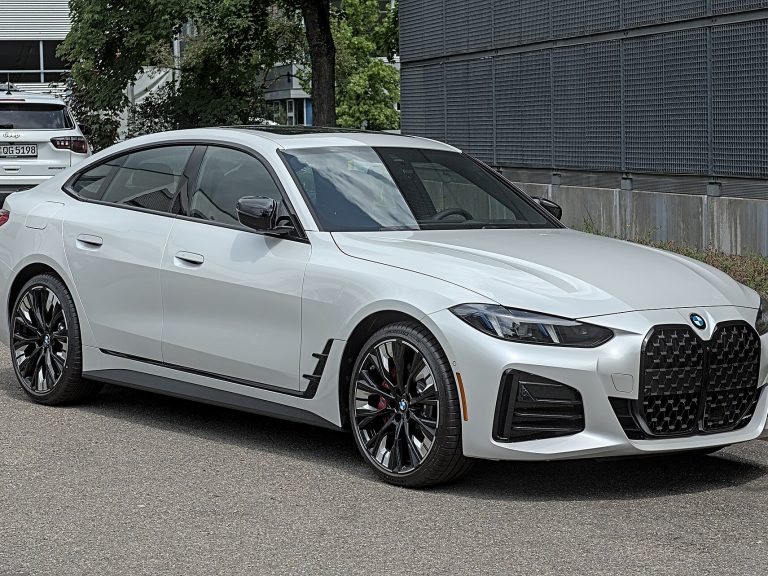
4 Series vs 911
The 4 Series and the 911 land in the same sports car category, so the comparison is fair, and the differences are telling. Where the 4 Series shines on fuel economy & range, the 911 counters on engine & performance.
At a glance
- Engine & Performance 911 wins
- Fuel Economy & Range 4 Series wins
- Space & Practicality Tie
- Off-road & Towing Tie
- Engine & Performance2.1
- Fuel Economy & Range7.2
- Engine & Performance4.1
- Fuel Economy & Range2.0
Spec scores (0 to 10) are calculated from manufacturer specs against other models in the same class. See how the formula works. They are not reviews or user ratings.
Key Differences
-
The 911 has 133 hp more power
The spread here is large: 388 hp on the 911 versus 255 hp on the 4 Series. Expect to notice it. More power helps with merging, overtaking and climbing hills, especially with passengers and luggage on board.
-
The 4 Series has better fuel economy
Of all the specs we compared, this is one where the 4 Series makes its strongest case: 31 mpg against 21 mpg. The 4 Series uses less fuel on the standard combined cycle, which matters most if you drive a lot.
-
The 4 Series has better city fuel economy
The 4 Series clearly leads on fuel economy (city), and 28 mpg versus 18 mpg is a difference that reaches well beyond the spec sheet. City fuel economy matters most if your driving is mostly short trips, traffic and stop-and-go commutes.
-
The 4 Series has better highway fuel economy
On fuel economy (highway), the 4 Series posts 36 mpg against 25 mpg for the 911, a gap big enough to feel in everyday use. Highway fuel economy matters if you cover long distances at steady speeds.
-
The 911 has 36 lb-ft more torque
Close, but not identical: the 911 lists 331 lb-ft and the 4 Series lists 295 lb-ft. More torque means stronger pulling from low speeds, which you feel when accelerating from a stop or climbing grades.
Design & Size
Engine & Performance
911 leads
This section belongs to the 911. In engine & performance, it leads the 4 Series by a margin that’s hard to ignore. The 911 answers with 133 hp more power. Power is only part of the story; weight, gearing and torque delivery shape how quick a car feels. The engine & performance verdict goes to the 911.
Total system output
4 Series: 255 hp 911: 388 hp The 911’s extra output gives it more in reserve when you need to get up to speed.
Torque
4 Series: 295 lb-ft 911: 331 lb-ft The 911’s extra torque makes it more relaxed when fully loaded or towing.
Fuel Economy & Range
4 Series leads
In the fuel economy & range category, the 4 Series isn’t just ahead; it’s clearly ahead. The 4 Series steps ahead thanks to better fuel economy. Official figures rarely match real-world driving exactly, but the ranking between two cars tends to hold. For anyone who cares most about fuel economy & range, the 4 Series is the safer choice.
Fuel economy (combined)
4 Series: 31 mpg 911: 21 mpg Better combined fuel economy lowers your running costs every week, and the savings add up over years of ownership.
Fuel economy (city)
4 Series: 28 mpg 911: 18 mpg In town, driving style has a big effect, but the 4 Series starts from a better baseline.
Space & Practicality
Too close to call
Side by side, the space & practicality figures for the 4 Series and the 911 barely differ. In short, space & practicality is a draw; the decision lies elsewhere.
Off-road & Towing
Too close to call
On paper, the off-road & towing comparison ends all square. Neither car gives you a reason to choose it on off-road & towing.
Safety & Tech
The safety & tech entries below are descriptive rather than numeric. Read them side by side to see where the 4 Series and the 911 part ways.
Full Specifications
Engine & Performance
| Spec | 4 Series | 911 |
|---|---|---|
| Powertrain | Gas (48V mild hybrid) | Gas |
| Engine | 2.0L turbo I4 | 3.0L twin-turbo flat-6 |
| Total system output | 255 hp | 388 hp (winner) |
| Torque | 295 lb-ft | 331 lb-ft (winner) |
| Transmission | 8-speed automatic | 8-speed dual-clutch (PDK) |
| Drivetrain | RWD (xDrive AWD available) | RWD (AWD available on Carrera 4 models) |
Fuel Economy & Range
| Spec | 4 Series | 911 |
|---|---|---|
| Fuel economy (combined)EPA estimate where available | 31 mpg (winner) | 21 mpg |
| Fuel economy (city) | 28 mpg (winner) | 18 mpg |
| Fuel economy (highway) | 36 mpg (winner) | 25 mpg |
Space & Practicality
| Spec | 4 Series | 911 |
|---|---|---|
| Seats | 4 seats | 4 seats |
Off-road & Towing
| Spec | 4 Series | 911 |
|---|---|---|
| AWD / 4WD available | Yes | Yes |
Safety & Tech
| Spec | 4 Series | 911 |
|---|---|---|
| Basic warranty | 4 yr / 50,000 mi | 4 yr / 50,000 mi |
“N/A” means the manufacturer does not specify the value or we could not confirm it. Figures marked “manufacturer rating” are the maker’s own claims, not our measurements.
Which One Should You Buy?
Choose the 4 Series if…
- you drive a lot and want lower running costs (31 mpg vs 21 mpg combined)
- you want better city fuel economy (28 mpg vs 18 mpg)
- you want better highway fuel economy (36 mpg vs 25 mpg)
Choose the 911 if…
- you merge, overtake or climb hills with a full load (388 hp vs 255 hp)
- you want more pulling power from low speeds (331 lb-ft vs 295 lb-ft of torque)
- you’re comfortable with how Porsche does things
Also Compared
Frequently Asked Questions
Which is better for most people, the 4 Series or the 911?
There’s no single right answer. The 4 Series leads on fuel economy & range and the 911 on engine & performance.
Executive Summary
On paper, the 4 Series and the 911 chase the same buyer. In the details, BMW and Porsche made different calls. What I like most about the 4 Series here is better fuel economy. The 4 Series also scores with better highway fuel economy. I don’t want to sell the 911 short, though: it has 133 hp more power.
Put simply, the 4 Series suits people who care about fuel economy & range, while the 911 suits people who put engine & performance first.
My pick: both are fair choices, with the 4 Series leaning toward fuel economy & range and the 911 toward engine & performance.
Personal opinion based on the data above. Your priorities may differ.