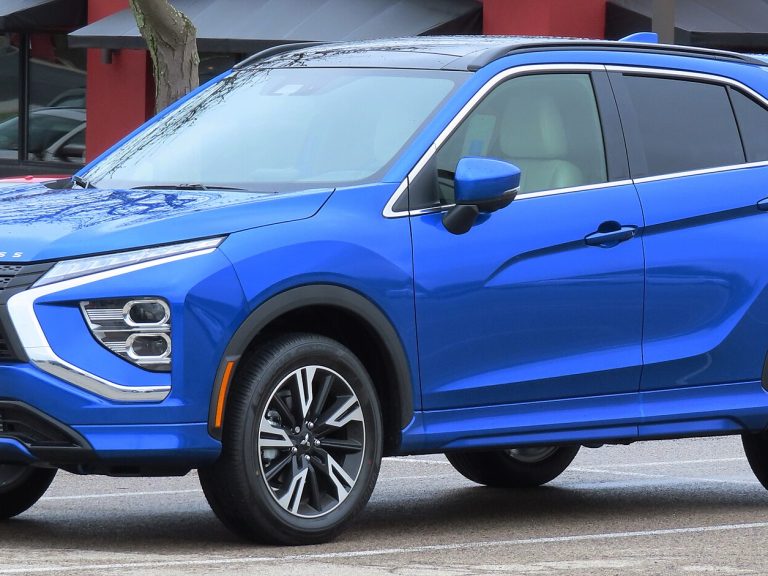
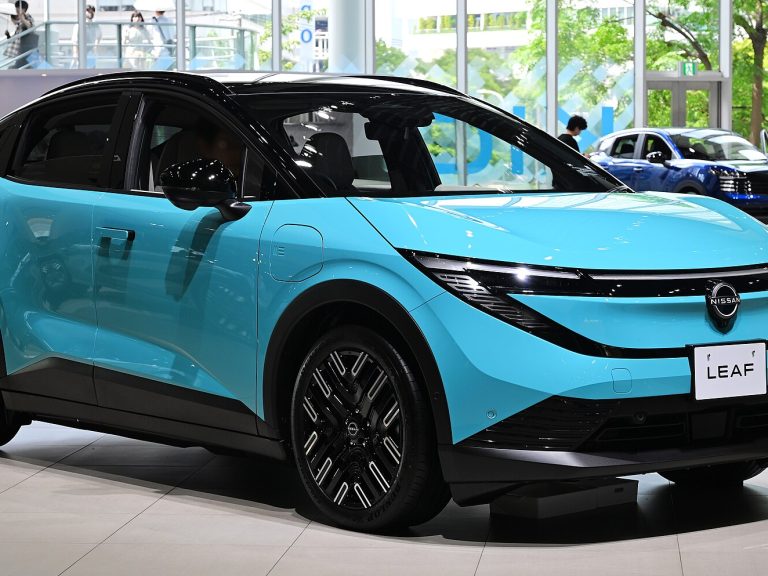
Eclipse Cross vs Leaf
The Eclipse Cross and the Leaf are direct rivals in the subcompact suv class, one from Mitsubishi and one from Nissan. Think of it as a split decision: the Eclipse Cross takes space & practicality, the Leaf takes engine & performance.
At a glance
- Engine & Performance Leaf wins
- Space & Practicality Eclipse Cross wins
- Off-road & Towing Eclipse Cross wins
- Safety & Tech Leaf wins
- Engine & Performance2.9
- Space & Practicality4.8
- Engine & Performance5.5
- Space & Practicality3.7
Spec scores (0 to 10) are calculated from manufacturer specs against other models in the same class. See how the formula works. They are not reviews or user ratings.
Key Differences
-
The Eclipse Cross has 17% more cargo space
Here the Eclipse Cross pulls well ahead of the Leaf, with 23.4 cu ft compared to 20 cu ft. Cargo space behind the rear seats is what you use every day for groceries, strollers and luggage.
-
The Leaf has 70 lb-ft more torque
The Leaf doesn’t just edge this one; 254 lb-ft against 184 lb-ft is a lead you’ll feel. The Leaf’s extra torque makes it more relaxed when fully loaded or towing.
-
The Leaf has 22 hp more power
The Leaf has a modest edge on total system output: 174 hp against 152 hp for the Eclipse Cross. Power is only part of the story; weight, gearing and torque delivery shape how quick a car feels.
-
The Leaf has a bigger 14.3 in touchscreen
Big gap, real consequences. The Leaf’s 14.3 in versus the Eclipse Cross’s 8 in changes how the two compare in daily use. Screen size isn’t everything (physical controls and software speed matter too), but bigger is easier to read.
-
The Leaf has 11% more maximum cargo space
It’s a small lead (55.5 cu ft versus 50.1 cu ft), but it’s real, and it goes to the Leaf. Maximum cargo space with the seats folded matters when you move furniture, bikes or bulky gear.
Design & Size
- Eclipse Cross 179 in × 71.1 in × 66.5 in
- Leaf 173.4 in × 71.3 in × 61.3 in
In overall size, the Eclipse Cross is ahead, which is good news only if a bigger car is what you want.
Dimensions
| Spec | Eclipse Cross | Leaf |
|---|---|---|
| Length | 179 in | 173.4 in |
| Width (no mirrors) | 71.1 in | 71.3 in |
| Height | 66.5 in | 61.3 in |
| Wheelbase | 105.1 in | 105.9 in |
| Curb weight (from) | N/A (not specified) | 4,187 lb |
Engine & Performance
Leaf leads
The Leaf wins the engine & performance section decisively. The Leaf delivers 70 lb-ft more torque. More torque means stronger pulling from low speeds, which you feel when accelerating from a stop or climbing grades. On engine & performance alone, the Leaf gets the nod.
Torque
Eclipse Cross: 184 lb-ft Leaf: 254 lb-ft Electrified powertrains deliver torque instantly, so compare torque figures alongside the powertrain type.
Total system output
Eclipse Cross: 152 hp Leaf: 174 hp More power helps with merging, overtaking and climbing hills, especially with passengers and luggage on board.
Space & Practicality
Eclipse Cross leads
When it comes to space & practicality, the Eclipse Cross is comfortably ahead. On the Eclipse Cross, you get 17% more cargo space. The Eclipse Cross’s larger cargo area makes family trips and big shopping runs easier. The Leaf scores with 11% more maximum cargo space. In short, the Eclipse Cross is the better-equipped car for space & practicality.
Cargo (behind rear seats)
Eclipse Cross: 23.4 cu ft Leaf: 20 cu ft Cargo figures are measured in different ways by different makers, so small gaps may not show in practice.
Cargo (seats folded)
Eclipse Cross: 50.1 cu ft Leaf: 55.5 cu ft Check the shape of the load floor too: a flat floor can matter as much as the number.
Off-road & Towing
Eclipse Cross leads
In the off-road & towing category, the Eclipse Cross is a step ahead rather than a leap ahead. The Eclipse Cross gives you available all-wheel drive. Available all-wheel drive improves traction in rain, snow and on loose surfaces. The off-road & towing verdict goes to the Eclipse Cross.
AWD / 4WD available
Eclipse Cross: yes Leaf: no All-wheel drive helps you get going on slippery roads, but good tires matter just as much for stopping and turning.
Safety & Tech
Leaf leads
The Eclipse Cross keeps it close on safety & tech, yet the Leaf holds a small lead. The Leaf adds a bigger 14.3 in touchscreen. A bigger touchscreen makes maps and phone mirroring easier to read at a glance. Bottom line for safety & tech: the Leaf has the edge.
Largest touchscreen
Eclipse Cross: 8 in Leaf: 14.3 in The Leaf’s larger display gives navigation and menus more room.
Full Specifications
Engine & Performance
| Spec | Eclipse Cross | Leaf |
|---|---|---|
| Powertrain | Gas | Battery electric |
| Engine | 1.5L turbo I4 | 130 kW electric motor, 75 kWh battery |
| Total system output | 152 hp | 174 hp (winner) |
| Torque | 184 lb-ft | 254 lb-ft (winner) Most torque in class |
| Transmission | CVT | Single-speed |
| Drivetrain | AWD (S-AWC) | FWD |
Fuel Economy & Range
| Spec | Eclipse Cross | Leaf |
|---|---|---|
| Fuel economy (combined)EPA estimate where available | 26 mpg | N/A (not specified) |
| Fuel economy (city) | 25 mpg | N/A (not specified) |
| Fuel economy (highway) | 28 mpg Thirstiest on the highway | N/A (not specified) |
| Electric range | N/A (not specified) | 303 mi |
| Fuel tank | 15.8 gal | N/A (not specified) |
Space & Practicality
| Spec | Eclipse Cross | Leaf |
|---|---|---|
| Seats | 5 seats | 5 seats |
| Cargo (behind rear seats) | 23.4 cu ft (winner) | 20 cu ft |
| Cargo (seats folded) | 50.1 cu ft | 55.5 cu ft (winner) |
| Rear legroom | N/A (not specified) | 31.80 in Least rear legroom |
Off-road & Towing
| Spec | Eclipse Cross | Leaf |
|---|---|---|
| Ground clearance | N/A (not specified) | 5.30 in Lowest ground clearance |
| Max towing | 1,500 lb | N/A (not specified) |
| AWD / 4WD available | Yes (winner) | No |
Safety & Tech
| Spec | Eclipse Cross | Leaf |
|---|---|---|
| Largest touchscreen | 8 in | 14.3 in (winner) Biggest touchscreen |
| Basic warranty | 5 yr / 60,000 mi | 3 yr / 36,000 mi |
Dimensions
| Spec | Eclipse Cross | Leaf |
|---|---|---|
| Length | 179 in | 173.4 in |
| Width (no mirrors) | 71.1 in | 71.3 in |
| Height | 66.5 in | 61.3 in |
| Wheelbase | 105.1 in | 105.9 in |
| Curb weight (from) | N/A (not specified) | 4,187 lb |
Price
| Spec | Eclipse Cross | Leaf |
|---|---|---|
| Starting MSRP | $27,695 | N/A (not specified) |
“N/A” means the manufacturer does not specify the value or we could not confirm it. Figures marked “manufacturer rating” are the maker’s own claims, not our measurements.
Which One Should You Buy?
Choose the Eclipse Cross if…
- you haul strollers, luggage or sports gear every week (23.4 cu ft vs 20 cu ft)
- you want all-wheel drive available
- you prefer a larger car and have the room for it
Choose the Leaf if…
- you often drive loaded up or with a trailer (254 lb-ft vs 184 lb-ft of torque)
- you want more power (174 hp vs 152 hp)
- you want the bigger touchscreen (14.3 in vs 8 in)
- you want more room with the seats folded (55.5 cu ft vs 50.1 cu ft)
Also Compared
Frequently Asked Questions
Which is better for most people, the Eclipse Cross or the Leaf?
The Eclipse Cross and the Leaf split the comparison (space & practicality for the Eclipse Cross, engine & performance for the Leaf), so pick the strength you’ll use.
Which is larger, the Eclipse Cross or the Leaf?
Size goes the other way: the Eclipse Cross is larger (179 × 71.1 × 66.5 in), and the Leaf is the smaller option (173.4 × 71.3 × 61.3 in).
Executive Summary
Here’s the short version of how I’d choose between the Eclipse Cross and the Leaf. To me, the standout is that the Eclipse Cross offers 17% more cargo space. And the Eclipse Cross doesn’t stop there; it also offers available all-wheel drive. Where the Leaf fights back is 70 lb-ft more torque.
I think of the Eclipse Cross as the one for space & practicality and the Leaf as the one for engine & performance.
My pick: decide whether you’d miss space & practicality or engine & performance more, then buy the Eclipse Cross or the Leaf accordingly.
Personal opinion based on the data above. Your priorities may differ.