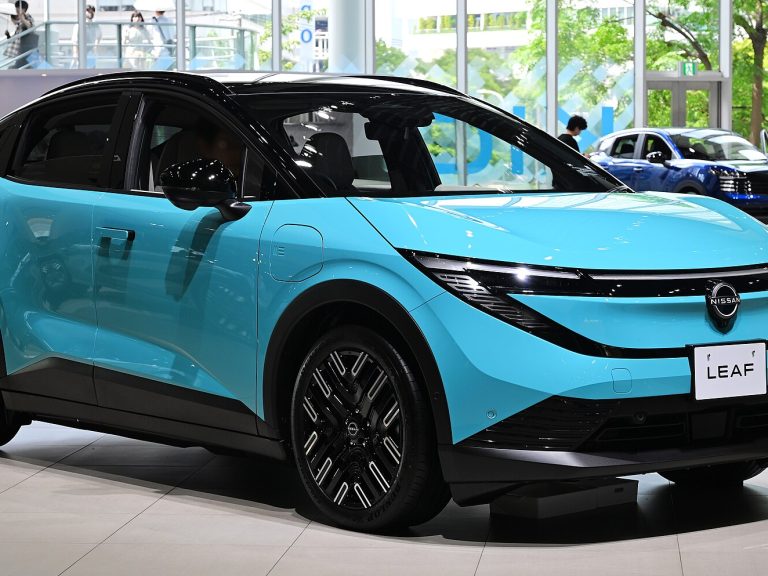
Leaf vs C-HR
Choosing between Nissan and Toyota often comes down to a specific pair of products. In the subcompact suv class, that pair is the Leaf and the C-HR. The data doesn’t leave much room for doubt: 3 of 5 areas go to the C-HR, and the gap is widest in space & practicality.
At a glance
- Engine & Performance C-HR wins
- Fuel Economy & Range Leaf wins
- Space & Practicality C-HR wins
- Off-road & Towing C-HR wins
- Safety & Tech Tie
- Space & Practicality3.7
- Space & Practicality7.0
Spec scores (0 to 10) are calculated from manufacturer specs against other models in the same class. See how the formula works. They are not reviews or user ratings.
Key Differences
-
The C-HR has 164 hp more power
Of all the specs we compared, this is one where the C-HR makes its strongest case: 338 hp against 174 hp. The C-HR’s extra output gives it more in reserve when you need to get up to speed.
-
The C-HR has 27% more cargo space
The C-HR clearly leads on cargo (behind rear seats), and 25.3 cu ft versus 20 cu ft is a difference that reaches well beyond the spec sheet. Cargo space behind the rear seats is what you use every day for groceries, strollers and luggage.
-
The Leaf has 16 mi more electric range
Close, but not identical: the Leaf lists 303 mi and the C-HR lists 287 mi. If you can charge at home, the Leaf’s longer electric range can cover more commutes on electricity alone.
-
The C-HR has 7.2% more maximum cargo space
The gap on cargo (seats folded) is slim (59.5 cu ft against 55.5 cu ft), yet it tips toward the C-HR. Check the shape of the load floor too: a flat floor can matter as much as the number.
-
The C-HR has available all-wheel drive
If you’ve come to rely on available all-wheel drive, note that the Leaf leaves it out. All-wheel drive helps you get going on slippery roads, but good tires matter just as much for stopping and turning.
Design & Size
- Leaf 173.4 in × 71.3 in × 61.3 in
- C-HR 177.9 in × 73.6 in × 63.8 in
The C-HR is the larger car of the two, while the Leaf is the more compact choice.
Dimensions
| Spec | Leaf | C-HR |
|---|---|---|
| Length | 173.4 in | 177.9 in |
| Width (no mirrors) | 71.3 in | 73.6 in |
| Height | 61.3 in | 63.8 in |
| Wheelbase | 105.9 in | 108.3 in |
| Curb weight (from) | 4,187 lb | N/A (not specified) |
Engine & Performance
C-HR leads
On engine & performance, the gap between these two is wide, and it favors the C-HR. The C-HR answers with 164 hp more power. Power is only part of the story; weight, gearing and torque delivery shape how quick a car feels. The takeaway: on engine & performance, the C-HR is the stronger car.
Total system output
Leaf: 174 hp C-HR: 338 hp More power helps with merging, overtaking and climbing hills, especially with passengers and luggage on board.
Fuel Economy & Range
Leaf leads
In the fuel economy & range category, the Leaf is a step ahead rather than a leap ahead. The Leaf comes with 16 mi more electric range. More electric range means more of your daily driving can happen without using fuel at all. The fuel economy & range verdict goes to the Leaf.
Electric range
Leaf: 303 mi C-HR: 287 mi Cold weather and highway speeds reduce electric range, so a larger buffer is useful.
Space & Practicality
C-HR leads
Look at the space & practicality table and one name keeps coming out on top: the C-HR. The C-HR scores with 27% more cargo space. The C-HR’s larger cargo area makes family trips and big shopping runs easier. Anyone shopping mainly on space & practicality should start with the C-HR.
Cargo (behind rear seats)
Leaf: 20 cu ft C-HR: 25.3 cu ft Cargo figures are measured in different ways by different makers, so small gaps may not show in practice.
Cargo (seats folded)
Leaf: 55.5 cu ft C-HR: 59.5 cu ft Maximum cargo space with the seats folded matters when you move furniture, bikes or bulky gear.
Off-road & Towing
C-HR leads
The C-HR edges the off-road & towing section, though the Leaf stays close. The C-HR makes its case with available all-wheel drive. Available all-wheel drive improves traction in rain, snow and on loose surfaces. Bottom line for off-road & towing: the C-HR has the edge.
AWD / 4WD available
Leaf: no C-HR: yes The C-HR offers all-wheel drive; the Leaf doesn’t, which matters if you face harsh winters.
Safety & Tech
Too close to call
Swap one for the other and you’d lose nothing on safety & tech. Treat safety & tech as common ground and look elsewhere for the deciding factor.
Full Specifications
Engine & Performance
| Spec | Leaf | C-HR |
|---|---|---|
| Powertrain | Battery electric | Battery electric |
| Engine | 130 kW electric motor, 75 kWh battery | Dual electric motors, 74.7 kWh battery |
| Total system output | 174 hp | 338 hp (winner) Most powerful in class |
| Torque | 254 lb-ft Most torque in class | N/A (not specified) |
| Transmission | Single-speed | Single-speed |
| Drivetrain | FWD | AWD |
Fuel Economy & Range
| Spec | Leaf | C-HR |
|---|---|---|
| Electric range | 303 mi (winner) | 287 mi Shortest electric range |
Space & Practicality
| Spec | Leaf | C-HR |
|---|---|---|
| Seats | 5 seats | 5 seats |
| Cargo (behind rear seats) | 20 cu ft | 25.3 cu ft (winner) |
| Cargo (seats folded) | 55.5 cu ft | 59.5 cu ft (winner) |
| Rear legroom | 31.80 in Least rear legroom | N/A (not specified) |
Off-road & Towing
| Spec | Leaf | C-HR |
|---|---|---|
| Ground clearance | 5.30 in Lowest ground clearance | N/A (not specified) |
| AWD / 4WD available | No | Yes (winner) |
Safety & Tech
| Spec | Leaf | C-HR |
|---|---|---|
| Largest touchscreen | 14.3 in Biggest touchscreen | 14 in |
| Basic warranty | 3 yr / 36,000 mi | 3 yr / 36,000 mi |
Dimensions
| Spec | Leaf | C-HR |
|---|---|---|
| Length | 173.4 in | 177.9 in |
| Width (no mirrors) | 71.3 in | 73.6 in |
| Height | 61.3 in | 63.8 in |
| Wheelbase | 105.9 in | 108.3 in |
| Curb weight (from) | 4,187 lb | N/A (not specified) |
Price
| Spec | Leaf | C-HR |
|---|---|---|
| Starting MSRP | N/A (not specified) | $37,000 Priciest in class |
“N/A” means the manufacturer does not specify the value or we could not confirm it. Figures marked “manufacturer rating” are the maker’s own claims, not our measurements.
Which One Should You Buy?
Choose the Leaf if…
- you can charge at home and want more of your daily driving on electricity (303 mi vs 287 mi)
- you value compactness over sheer size
- you’re loyal to Nissan and happy with it
Choose the C-HR if…
- you merge, overtake or climb hills with a full load (338 hp vs 174 hp)
- you want more cargo space behind the rear seats (25.3 cu ft vs 20 cu ft)
- you move bulky items now and then (59.5 cu ft vs 55.5 cu ft maximum cargo)
- you face snow, ice or slippery back roads
Also Compared
Frequently Asked Questions
Which is better for most people, the Leaf or the C-HR?
The C-HR wins more of the areas we compared, so it’s the safer pick unless you need 16 mi more electric range, which only the Leaf offers.
Which has better battery life, the Leaf or the C-HR?
The Leaf does better here. It lists 303 mi for electric range, while the C-HR lists 287 mi.
Is the Leaf bigger than the C-HR?
The C-HR takes that one. With dimensions of 177.9 × 73.6 × 63.8 in, it is larger than the Leaf (173.4 × 71.3 × 61.3 in).
Executive Summary
The Leaf and the C-HR are aimed at each other, and I think the gaps between them are more interesting than the headlines. The C-HR earns my vote first and foremost with 164 hp more power. The C-HR also scores with 27% more cargo space. Fairness check: the Leaf does come with 16 mi more electric range.
The Leaf is built for people who weigh fuel economy & range heavily, and the C-HR for people who weigh engine & performance.
My pick: the C-HR for most people, with the Leaf as the smarter choice if you specifically want 16 mi more electric range, where the Leaf has the edge.
Personal opinion based on the data above. Your priorities may differ.